Today, after practicing basic Ippon uchi no waza (one-strike techniques) for men, kote, and dō, I moved on to jigeiko.
It had been a while since I recorded my practice on video, so I checked it as soon as I got home… and there it was again—that same pattern.
During Ippon uchi practice, my posture was fairly correct, and I was able to strike men with ki-ken -tai no icchi.
However, in jigeiko, once again, my right foot was clearly landing before the strike. This lack of synchronization wasn’t at an “almost there!” level—it was so obvious that I could feel it myself during practice.
Uwaaa… not again…
Why does this keep happening? While the memory was still fresh, I watched the video over and over, trying to figure it out.
To be honest, repeatedly watching my own clumsy performance feels like digging into my heart again and again—it’s a painful, unpleasant task. And since I was watching in slow motion, it was basically torture.
B-but—but still! This is a path I cannot avoid if I want to improve! I will push forward!
Even for someone like me
with masochistic tendencies,
this is tough…
Here’s a summary of my thoughts:
In kihon practice, the motodachi offers a clear target (openings), like “Okay, Haru-chan, strike here!”
In ippon uchi kihon practie, there’s no need to worry about the opponent countering with debana-waza or oji-waza, so I was able to stay relaxed and can focus on executing each waza with ki-ken-tai noicchi.
Phew♡
I can finally do it!
However, in jigeiko, I have to create openings and execute and finish waza.
The moment I tried to control the opponent’s shinai and execute waza—whether shikake-waza (initiating an attack) or drawing opponent’s reaction for counter attack—my ki-ken-tai no icchi began to collapse.
So what’s going on here? After thinking about it, this is what I came up with:
I searched for the cause with Kendo Cat
In ippon uchi kihon practice, everything is completed in a single movement—one beat.
But in actual matches like jigeiko, there are two movements: controlling the opponent’s shinai and executing my strike. Both must be completed within a single beat for my waza to succeed.
However, I was using up almost an entire beat just on controlling the opponent’s shinai—whether by harai(knocking it aside), osae(suppressing it), suriage (sliding up), or kaeshi (deflecting it).
This is where I went wrong.
What I also realized is this: for example, today I tried a waza where I suppress the opponent’s shinai from above and strike men. But clearly, I was doing it in one-and-a-half to two beats—“suppress, and then strike men.” I was paying far too much attention and taking too much time to do the newly added movement of “suppressing.”
I totally get that feeling!
I’m the same!
Come to think of it, I’ve felt this before with some waza like suriage-men and men-kaeshi-dō.
The moment I executed the suriage, I’d think, “Yay! I did suriage part!”
Or during the block in men-kaeshi-dō, “Oh! Successful block!”
And right there, I had already used up the entire beat—making both waza clearly “two-beat movements”.
The big difference between one beat and two beats?
Needless to say, once it becomes two beats, my right foot comes down “too early” and the whole waza is no longer ki-ken-tai no icchi.
That’s why, whether I’m knocking aside, suppressing, sliding up, or deflecting the opponent’s shinai—whatever I do—those movements and the final decisive striking generally should all fit within a single beat.
Yes…
That’s a useful rhythm to aim for.
But then another question came up: if the tempo changes, the length of one beat also changes—so what exactly is the standard for “one beat”?
For now, I decided that in this context, “one beat” probably refers to the interval from the moment I begin pushing my body forward with my left foot until just before my right foot lands.
As I thought this through… I started groaning again.
Can I really do two different movements in one beat?
After having my heart torn apart by the video and my brain overheating, I took a nap and thought about it some more. And during that nap, a hypothesis emerged.
When you’re tired,
resting really is best
I think I had been treating the two movements—like in suriage-men, the sliding motion and the strike—as equally important, with each occupying their own beat. That’s why it was basically impossible to complete both of them within one beat.
If the most important thing is the final decisive striking, then the suriage motion should be thought of as just a slight detour leading into the men strike. Otherwise, fitting both movements into one beat would be impossible.
It’s “suriage-men,” but in reality… The timing is almost just “men.”
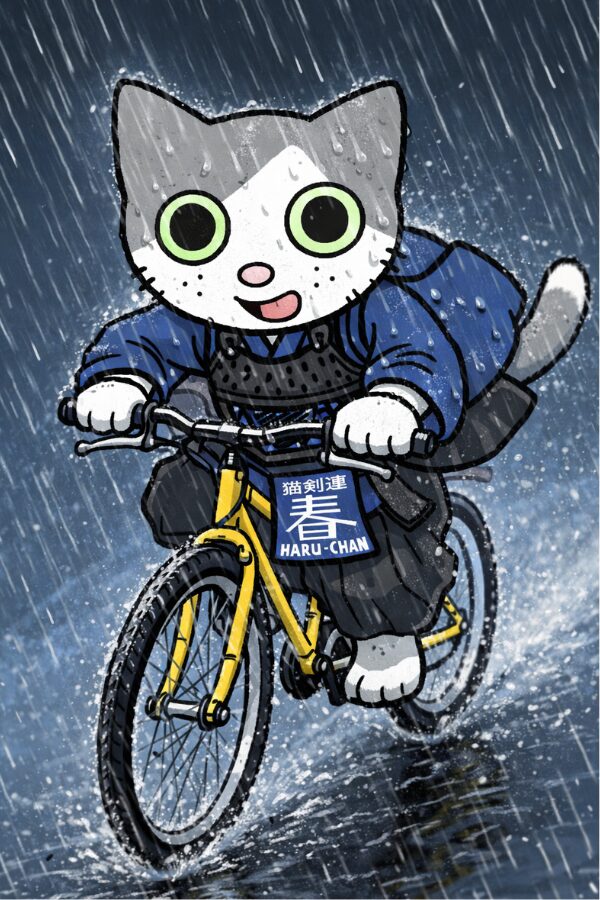
And at that moment, an image suddenly came to mind: 🌸Haru is riding a bicycle in the rain.🌸
Entering ♡Haru-chan World♡—this part might make no sense at all, so feel free to skip it♡
I’m pedaling hard so I won’t be late for practice…
Rain pours down relentlessly into my face,
But I keep pushing forward toward my destination.
At that moment, I don’t bother swatting away each raindrop with my hands!
No matter how heavy the rain is, I push forward with strong determination, using my whole body—unconsciously brushing the rain aside.
S-so maybe this is the right image for my suriage-men…
In other words, to move forward, I do need to deal with the rain—but I shouldn’t try to avoid every single drop. If I spend too much time and effort being destructed by each raindrop, I will never get to the dojo.
There are two movements—controlling the opponent’s shinai and finishing the strike—but within that single beat, maybe about 80 % of the focus should be on executing a sharp, proper men striking.
So for any shikake waza or ouji waza, I want to keep the rhythm of basic ippon uchi no waza as the core. The initial movements—harai, osae, suriage, or kaeshi—should be done properly using the shinai without letting it drift off center, but also without “overdoing” them… I want to avoid putting the cart before the horse.
In the end…
it all comes back to basics again!
If I were to express it in sound:
PANN! (🍞!) — that’s a ippon uchi no waza
It’s not PANN – PANN! (🍞–🍞!) but PA-PANNN! (🍞🍞!) when controlling the shinai and striking
Easier said than done, but I’ll believe that noticing my mistakes means I’m one step closer to success.
And with that, I’ll head to practice again tomorrow♪
Bonus: 🌸Image of Haru-chan World🌸
【Comment Dojo】