I suspect that for most kendo practitioners, the very first technique they learned when they started kendo was probably “big men.” That was the case for me, too.
From the kamae, raise the shinai in a large arc and strike men solidly with the unity of spirit, sword, and body-Ki-ken-tai no icchi.
I have repeated this practice over and over again, piling it up through countless sessions. I still do it today. Come to think of it, the shomen-uchi and the left and right men strikes in kirikaeshi are also performed as big men, aren’t they?
But when you actually watch matches or shinsa, of course you do see techniques delivered with big men, yet it feels like the so-called “small men” appears far more often.
When we hear “small men,” we tend to imagine simply shrinking big men down into a smaller version of the same movement. But that’s not really the case. Small men uses a different mechanism from big men and strikes men in a compact way. So the term “small men” feels like it fits, and at the same time doesn’t quite fit… but leaving the name aside for now…
Here, one question arises.
Why is it that in actual practice, techniques using small men are overwhelmingly more common, yet we are first taught big men, and then, as long as we continue kendo, we go on practicing big men endlessly?
While thinking about this simple question, I headed off to work at the bakery.
As usual, I was slicing tomatoes, loaf of bread, and mozzarella cheese for sandwiches. And at that moment, I had a sudden realization.
Huh! Oh! Maybe this is it!

Haru Senpai,
you’re thinking about kendo even while you’re at work, huh
At my workplace, we slice tomatoes, bread, and mozzarella cheese by hand with a knife, without using machines. Since these are things we charge money for and serve to customers, we’re expected to slice them neatly and thinly.
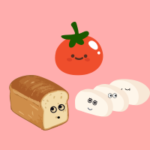
Please send us off as beautiful slices
When I first started this job, this was surprisingly difficult, and there was a time when I just couldn’t do it well.
Just the other day, a new person joined us, and while I was teaching them how to slice, the very first thing I told them was, “Don’t use too much force. Relax while you cut.”
Hehe,
even at the bakery, I ended up acting like a senpai.
The next thing I taught was, “Don’t saw the knife in tiny, choppy movements with your hand. It’s fine to go slowly, but move the blade largely back and forth in a straight line. Don’t try to cut with your hand.”
And the last thing I said was, “This might feel a bit strange, but try cutting while feeling the blade of the knife with your heart,” which was a rather kendo-otaku-like piece of advice. The newcomer looked a little bewildered…
That’s right.
I realized that this technique of thinly slicing tomatoes, bread, and mozzarella cheese is somehow similar to the teaching of big men.
What I mean is this: by performing movements slowly and on a large scale, we can check whether each individual movement we’re supposed to do is being done correctly.
For example, a common mistake is trying to cut tomatoes or cheese with brute force, or rushing the cut to cover up movements you are not comfortable with. In no time at all, both the tomato and the cheese lose their shape, or you end up with thick, uneven slices, and a beautiful slice cannot be achieved.
As for sandwich bread, the more force I apply and the more I rush, the more the knife slips or the bread itself gets crushed. The knife won’t enter the crust properly at all.
In other words, it’s important to understand where on the knife it can exert its power most effectively, and under what conditions that power can be brought out to the fullest. And beyond that, while staying relaxed and keeping my mind straight, my slice with a sense of cooperation between myself and the knife. Only then are beautiful slices born.
A joint task between the knife and me ♡
It’s like cutting a wedding cake. Huh? Where did the husband go?
If I want to check whether I myself are performing this whole sequence of movements correctly, I need to do each movement largely and slowly. By repeating this many times, the movements naturally become ingrained in my body, and as a result, I supposed to be able to perform them correctly and naturally without conscious effort.
Yeah!
That is hyakuren jitoku!-百錬自得
So maybe this is the meaning of starting with big men, and continuing to practice it.
While moving largely and slowly, I can check at each stage whether I’m using my body correctly, whether spirit, sword, and body are unified, whether my strike is not just a tense, forceful blow, and whether I can maintain zanshin continuously even after the strike. To check all of this, isn’t it necessary to practice big men?
Somehow, I feel that the significance of learning through big men lies in teaching my body—or reminding it—that “this is the kind of feeling a strike should have.”
Am I cutting the tomato properly without crushing its shape, using correct body mechanics? If I feel that it’s not going well, where do I need to make corrections? Making myself think about these things may be one of the reasons big men practice exists.
So when I change my way of striking from big men to small men, if I feel some kind of “discomfort,” that discomfort is probably a message from big men saying, “Hey, hey, what you could do with big men, you suddenly can’t do anymore once it becomes small men.”

You’ve got a message from Mr.Big Men!
When I started practicing small men, the first discomfort I felt was in the feeling of the strike.
With big men, little by little, I had begun to feel that sense of “Yeah, I really struck that solidly!” But the moment it became small men, if I were to express the strike feeling with sound effects…
“Funya!”
“Peto!”
“Ngyu!”
It turned into a strike that sounded like that.
Of course, the movement of the shinai is very different between big men and small men, so it’s unavoidable that the strike feeling would differ. But mine felt more like… well, like trying to cut sandwich bread and having the bread say,
“Hey! You’re not cutting me at all!”
“The knife isn’t even getting into my crust!
That’s what it felt like.
That’s why I can confidently think to myself, “I must be doing something wrong in the way I strike small men.”
Not cutting at all—are you okay?
I know!
I’m not okay!
But when I thought about it…
I realized that I was able to notice this precisely because I had practiced big men.
Just because it becomes small men does not mean the strike can be weak. Even when striking small men, I must study how to use my body, my hands, and my spirit so that I can still feel that sensation of truly cutting.
And so, I need to keep practicing big men, while also striving for sharp, crisp strikes even with small men.
Whether striking big, or striking small and compact, I want to slice tomatoes, cheese, and sandwich bread cleanly and sharply.
So with that, I’m off to practice again tomorrow! ♪
Comments